Your marketing, actually done
Not a dashboard that tells you what to do and leaves the work on your desk. Percision Marketing Studio plans the campaigns, writes and publishes the content, buys and pauses the ads, runs the outreach — and tells you what each customer cost.
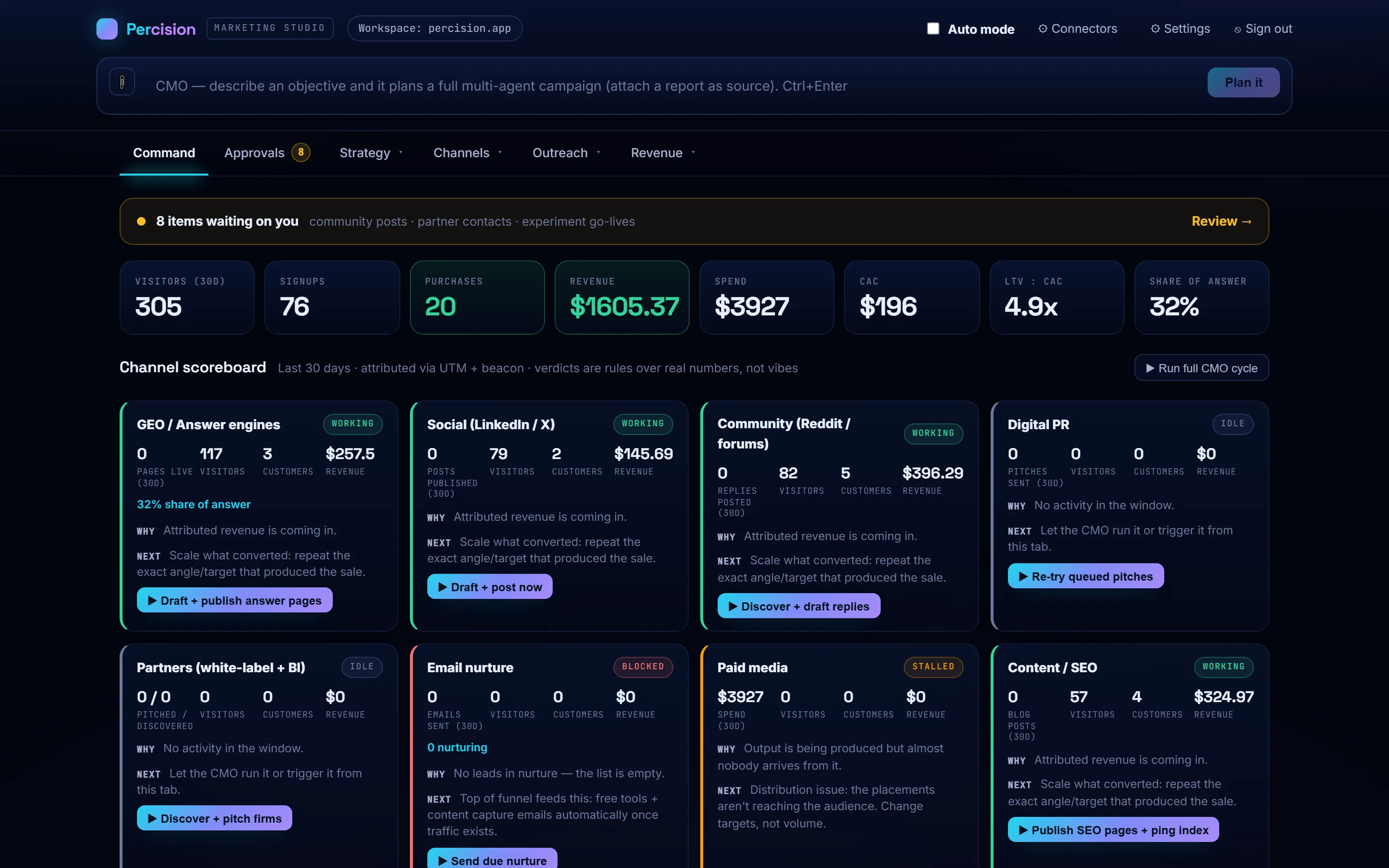
What is inside it
Fifteen screens, grouped into five menus, in the order the work actually happens: what happened, what needs you, what was decided, where demand comes from, and what it turned into.
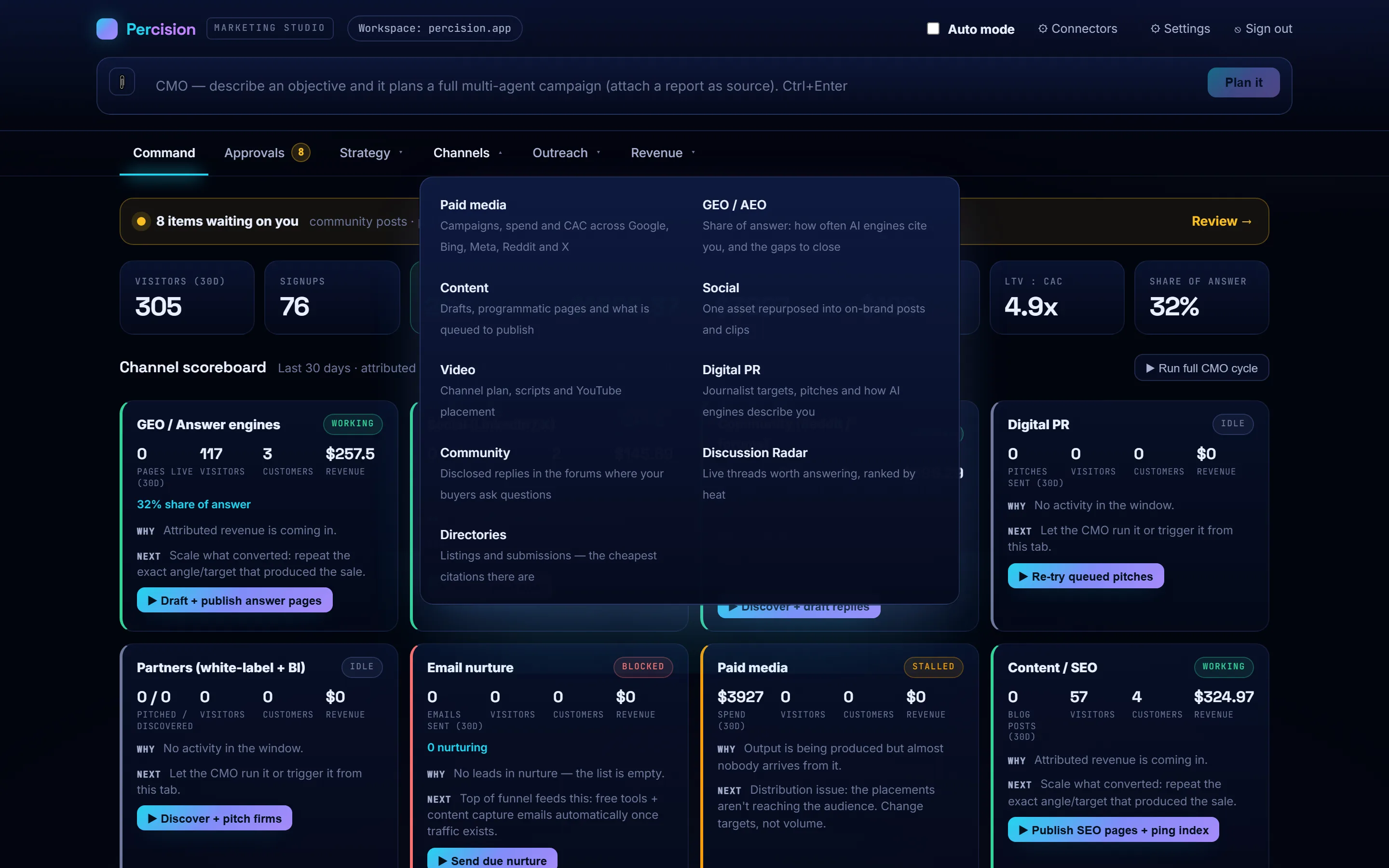
Paid media
Campaigns, spend and cost per customer across Google, Microsoft, Meta, Reddit and X — read from the platforms, not from a spreadsheet.
GEO / AEO
How often AI answer engines cite you when someone asks your buyer's question, and a plan for the ones they don't.
Content
Drafts, programmatic pages and what is queued to publish — to your own domain, in your voice.
Social
One asset turned into on-brand posts and clips, posted through your own connected accounts.
Digital PR
Journalist targets, drafted pitches, and what AI engines currently say about you.
Community
Disclosed, useful replies where your buyers actually ask questions. Never covert, never a fake persona.
Directories
Listings and submissions — the cheapest citations on the internet, and the dullest work in marketing.
Partners & affiliates
Find the firms who could resell you, write the pitch, send it, chase it, and hand you the conversation when they reply.
Leads & RevOps
Anonymous traffic to known lead to paying customer, with the attribution that makes CAC a real number.
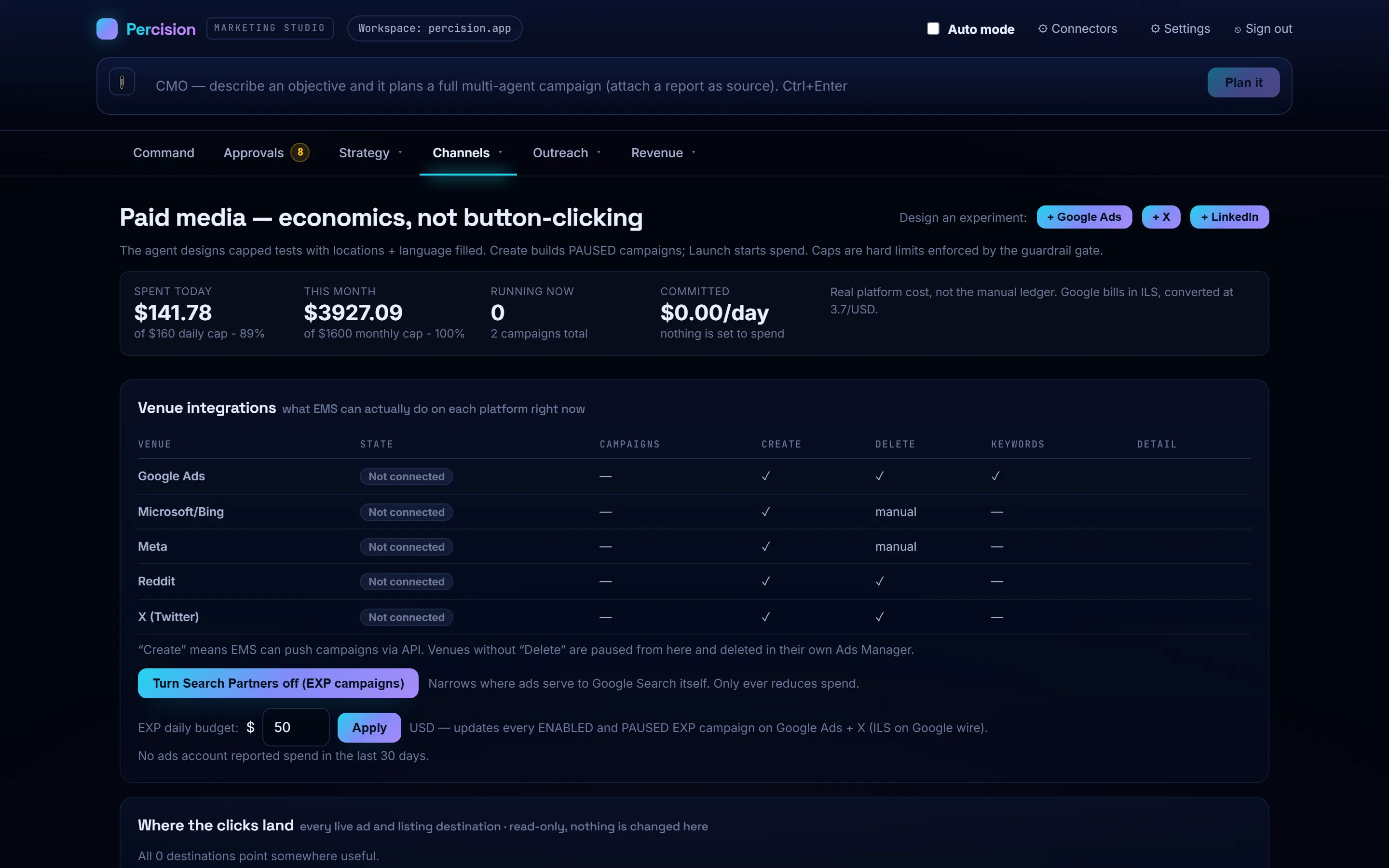
It spends money, so it shows you the caps first
Spend today against the daily cap. Spend this month against the monthly cap. What is committed per day. The figures come from what the ad platform itself reports, converted from the account's own currency — not from a ledger a human remembered to update.
Campaigns are created paused. A person turns them on. The venue table is honest about what the Studio can actually do on each platform rather than implying it can do everything everywhere.
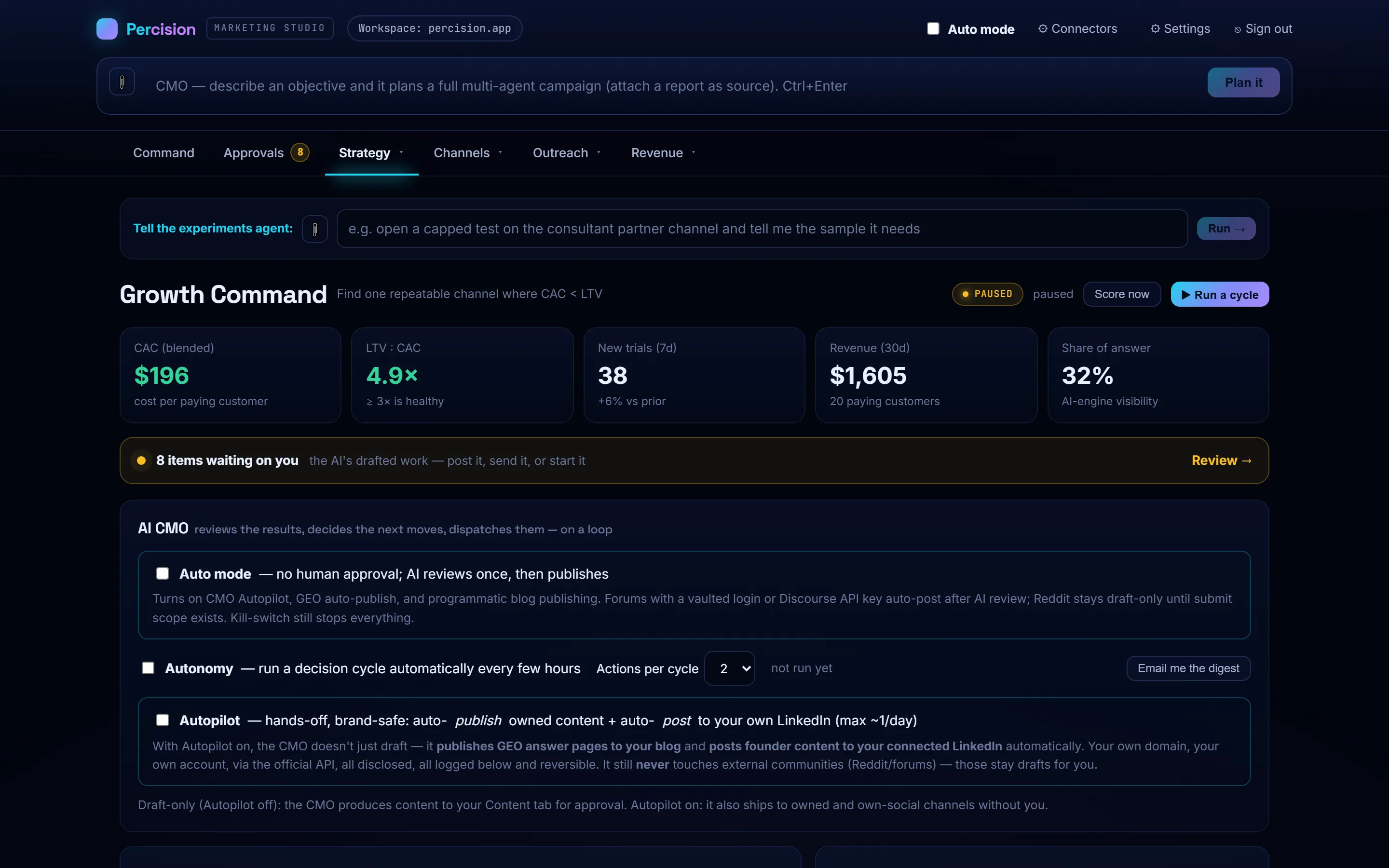
One question, asked continuously
Is there a channel where a customer costs less than they are worth? Growth Command runs capped experiments to find one, kills the losers, and says why.
The autopilot's switches sit on the same screen as its decision log, so what it is allowed to do and what it actually did are never two different pages. Every cycle records what it read before it decided — which is what makes a decision checkable rather than merely asserted.
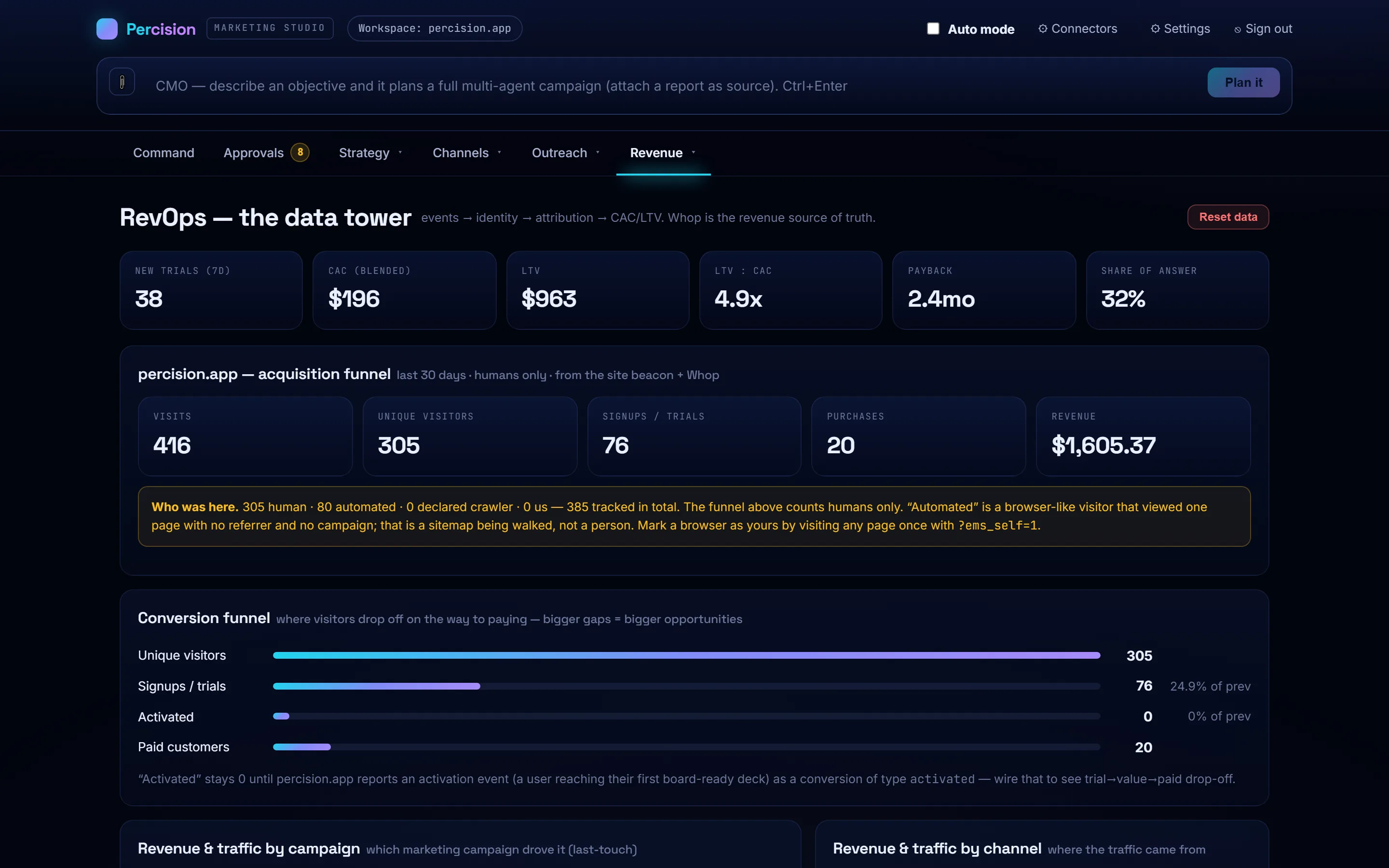
Where the money actually came from
Events to identity to attribution to CAC and LTV. Purchases are matched back to the click that produced them, including sales that complete off-site through a payment provider — the gap where most marketing attribution quietly gives up.
Stages that are not recording say so, in orange, above the funnel. A funnel that hides its own blind spots is worse than no funnel.
What stops it doing something stupid
An agent with your ad account and your brand voice is only worth having if it cannot embarrass you. Every outward action passes the same ordered gate, and a refusal names which link stopped it.
Disclosure is not configurable. Agents say who they represent; there is no setting that turns a disclosed reply into an anonymous one.
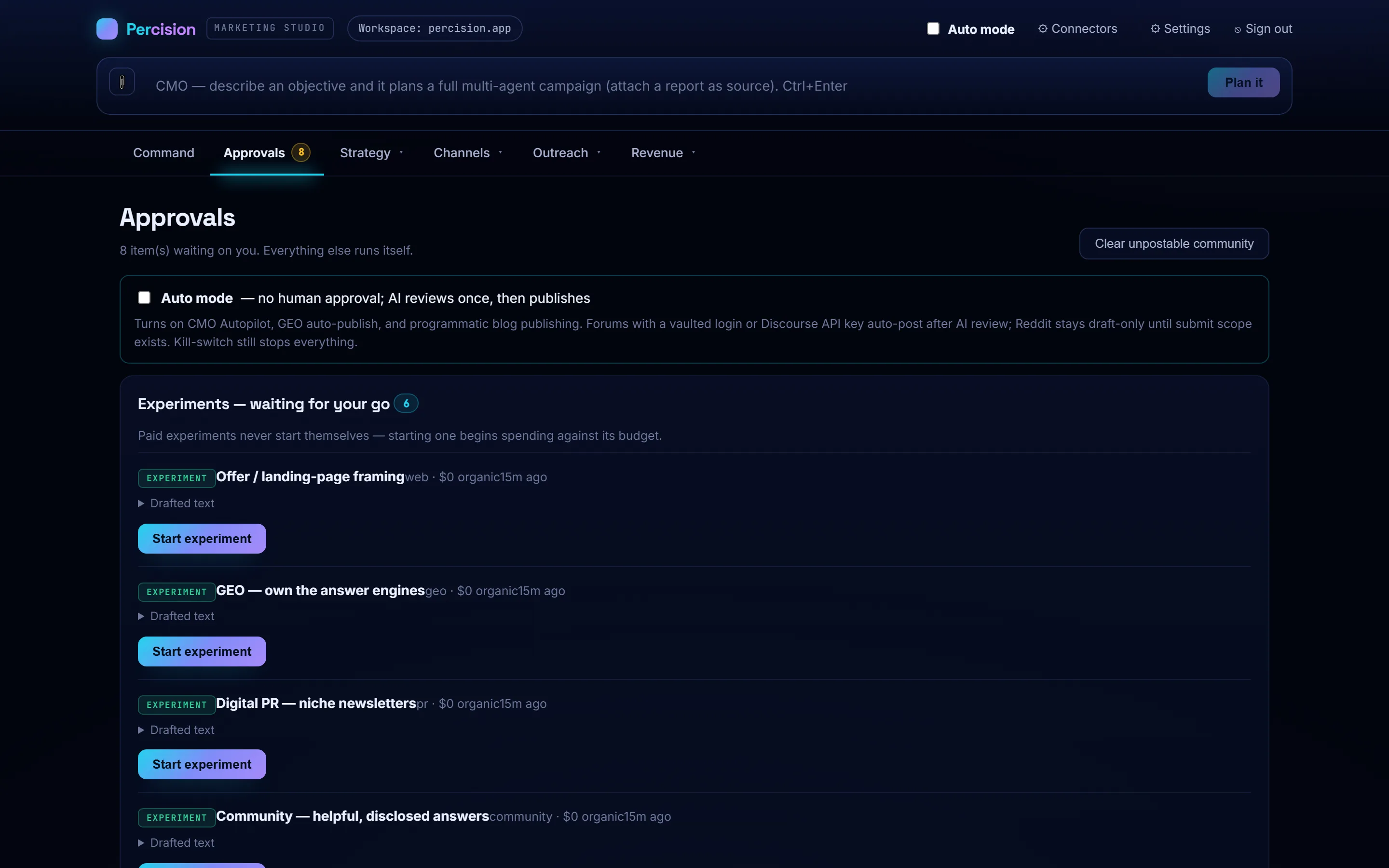
One queue, and it can finish the work
Everything needing a person lands in Approvals with the drafted text attached: approve and post, send, start, or dismiss. You set how much it decides alone — start with approval on everything and raise the autonomy as it earns it.
When the queue is empty it says so plainly. Most of the time it is empty, which is the point.
How it runs
- You describe an objectiveIn a sentence, in the box at the top of every screen. "Open a capped test on the consultant partner channel and tell me the sample it needs." Attach a report and it will read it.
- It plans a campaign across the disciplines that fitAgainst your economics and your market, not a template. The plan names each agent, what it will do, and why that step is in the plan at all.
- It does the workWrites and publishes, creates the paid campaigns paused, sends the outreach, replies where replying is welcome. Everything passes the gate above on the way out.
- You clear the queue, when there is oneApprovals holds whatever needs a human. On a quiet week that is nothing.
- It reports what each customer costPer channel, per campaign, against LTV. Then it decides what to do more of — and what to stop.
What it plugs into
Your accounts, your domain, your voice. Credentials are stored encrypted and the Studio posts as you — never through an intermediary account that could vanish and take your history with it.
Language models are bring-your-own-key — Anthropic, OpenAI, Google, xAI or Perplexity. You choose which model does which job, and the Studio records which one actually answered, not which one was asked. Those are different facts when a provider fails over, and pretending otherwise is how a report ends up labelled with a model that never saw it.
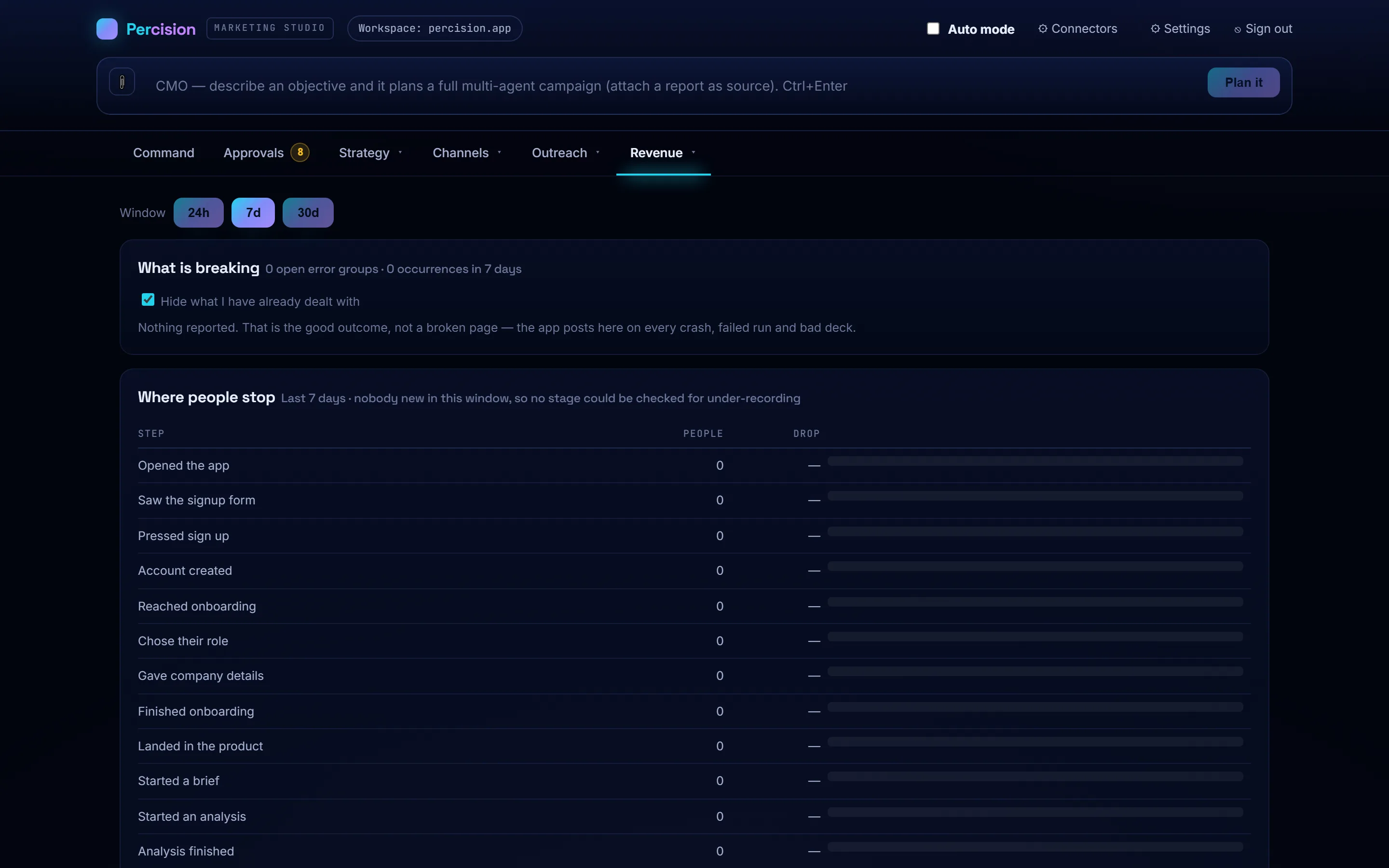
It reads your product before it sells it
A broken signup makes every channel above it a waste of money, so Product health sits second in the menu, not last. It shows what is currently crashing and exactly where people stop inside your product.
Steps that are not recording are named in orange above the funnel, because "nobody reached this step" and "we never measured this step" look identical and mean opposite things.
Who this is for
| You are | What changes |
|---|---|
| A founder doing your own marketing | The work gets done on the weeks you are busy — which is most weeks. You read what happened instead of finding time to do it. |
| A company with one marketer | They stop being the bottleneck on execution and start directing it. The dull half — listings, syndication, follow-ups — stops eating their week. |
| An agency | Run it white-label across client accounts, each in its own workspace with its own connectors, caps and numbers. Nothing crosses between them. |
| Spending on ads with no idea of CAC | You get a real cost per customer per channel, including the off-site sales most attribution drops — and an honest "unknown" where the data cannot support a number. |
Questions people actually ask
Is this a dashboard, or does it do the work?
It does the work. A dashboard reports on marketing somebody else performed. The Studio plans the campaign, writes and publishes the content, creates and pauses the paid campaigns, sends the partner outreach, and then reports what each customer cost. Approvals is where anything needing a person waits; everything else runs without you.
What stops it spending my money or embarrassing my brand?
Every outward action passes an ordered gate: kill-switch, disclosure, brand safety, platform terms, rate limit, spend cap, autonomy level. Spend caps are checked against what the ad platform itself reports, not a ledger someone fills in by hand — an earlier version trusted the ledger, believed nothing had been spent, and was wrong by the price of a campaign running at $100 a day. Paid campaigns are created paused; a person turns them on.
Will it post as a fake person?
No, and there is no setting for it. Agents disclose who they represent on every external reply. Community engagement is useful and signed, or it does not go out.
How does it know what a customer cost?
It matches purchases back to the click that produced them, including sales that complete off-site through a payment provider, and reports CAC and LTV:CAC per channel. A figure it could not measure shows as unknown rather than zero. A nought and an absence are different facts, and software that treats them the same is flattering itself.
Do I need to bring my own API keys?
For the language models, yes — Anthropic, OpenAI, Google, xAI or Perplexity, whichever you already pay for. Ad platforms, email and analytics connect to the accounts you already own. Nothing is rented back to you at a markup.
Can I run more than one brand in it?
Yes. Each product or client is its own workspace with its own connectors, caps, funnel and numbers, and nothing crosses between them. Percision runs two in it.
How is this different from Percision CMO?
Same product, different half of the sentence. Percision CMO is the agent — the thing that decides what to do next. The Marketing Studio is where it does it, and where you watch it. If you are buying the outcome, read the CMO page; if you want to see the software, you are on the right one.
See it running on your numbers
Twenty minutes. We open the live account that runs our own marketing, show you the real cost per customer, and connect one of your channels so you can see what it reports back. No deck.
Request access